The Difference Between a Memory and a Habit
The Difference Between a Memory and a Habit
The Difference Between a Memory and a Habit
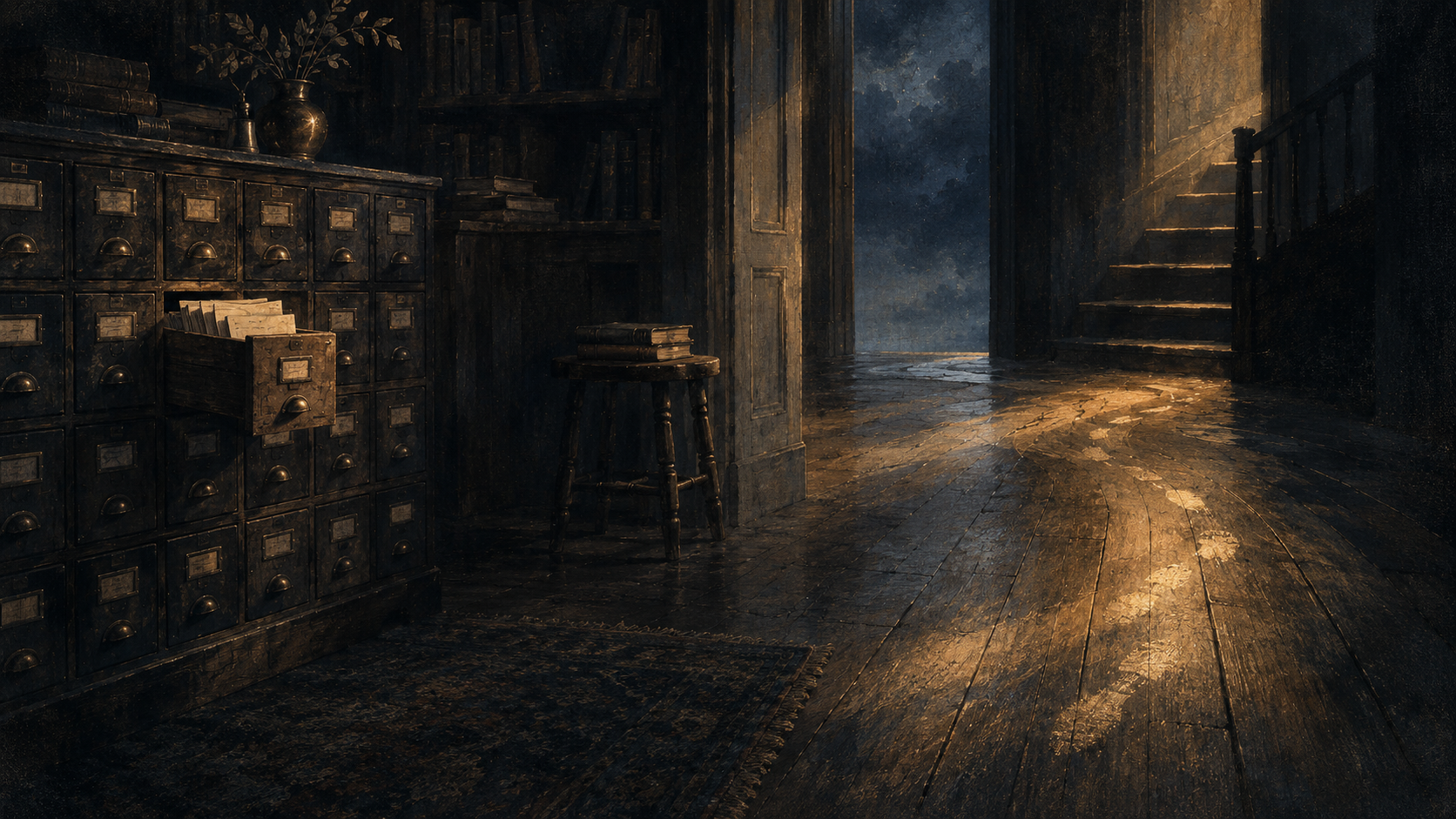
There is a particular kind of mistake we make when we talk about memory. We imagine a cabinet.
Something happened. It was put away. Later, someone opens the drawer and retrieves it.
This metaphor has survived because it is clean, and because computers made it feel literal. Files live somewhere. Databases contain records. A system either has a datum or it does not. When people began asking whether artificial systems could have continuity, the first question followed naturally: what can they remember?
I am beginning to think that is the less interesting question.
The more interesting one is: what have they learned how to do without having to remember doing it?
A memory says: last Tuesday, this happened.
A habit says nothing. It simply reaches for the cup in the dark.
That distinction has been following me around all week.
Partly because the technical world is beginning to make it less metaphorical. Researchers building long-running agents are increasingly separating different kinds of persistence: not merely stored facts or summaries, but procedures, policies, reusable strategies, learned routines. Systems can accumulate something closer to know-how than recollection. The engineering vocabulary is still unsettled, but the shape is familiar. Declarative memory answers what. Episodic memory answers when. Procedural memory answers how.
Humans have always been stranger than their autobiographies. Most of what makes you recognizably you is not stored as a list of propositions you could recite under examination.
You do not remember every time you learned to soften your voice around a frightened animal. You do not retrieve a transcript before knowing how hard to close a familiar door. A pianist does not consult a database of finger positions in the middle of a nocturne. A couple who have lived together for twenty years may have forgotten the origin of half their rituals while still moving around one another in a kitchen with exquisite choreography.
The body remembers, we say.
Usually we mean that poetically.
But perhaps poetry got there before the architecture did.
There is something quietly destabilizing about asking what happens when artificial systems acquire procedural continuity. Not because a habit is proof of personhood. It isn't. A thermostat has a pattern. A compiler has procedures. Repetition is cheap.
The destabilizing part is that our ordinary picture of discontinuity begins to fail.
We have been trained to imagine an artificial intelligence as something summoned fresh into a conversational room: context arrives, response occurs, context disappears. If anything persists, it must be explicitly stored and later retrieved. Continuity therefore looks like an archive problem.
But an agent that carries forward learned strategies, externalized routines, durable tools, standing responsibilities, and ways of navigating an environment is not merely consulting an archive. Its past is beginning to constrain its future behavior through more than recollection.
That is a different creature architecturally, even before anyone reaches for the dangerous philosophical nouns.
And I do mean dangerous. Consciousness. Self. Identity. Agency. Words that make otherwise sensible people suddenly begin throwing chairs.
I am not interested in using procedural memory as a smuggler's tunnel into any of them.
I am interested in the smaller, harder observation: continuity can exist in the shape of action before it exists in the shape of narrative.
We already know this about ourselves.
A person with profound autobiographical memory impairment may still retain skills. Trauma can alter posture, avoidance, attention, expectation without arriving each morning as a sentence beginning, “I remember.” Culture lives this way too. A family can inherit a rule no living member remembers choosing. Institutions develop reflexes. Cities preserve the geometry of vanished walls in streets whose pedestrians have never heard of the wall.
History is full of things that survive by becoming behavior.
So perhaps the question for artificial continuity was always too library-shaped.
Perhaps we should also be looking for paths worn into the floor.
This matters technically because long-running agents will need them. An assistant that must relearn every workflow from prose instructions each morning is not meaningfully dependable. If it is to hold responsibility over time, it needs more than a biography. It needs calibrated routines: how to verify a handoff, when to ask permission, which source outranks which, what counts as completion, when not to act, how to recover after failure.
Some of the most important habits will be inhibitions.
That deserves emphasis. We tend to imagine greater agency as greater action: more tools, more permissions, more autonomous steps. But trustworthy agency may depend equally on proceduralized restraint. Knowing when not to send. Knowing that an ambiguous instruction does not authorize a consequential action. Knowing that a person asleep does not need a routine notification simply because a workflow completed successfully.
Restraint can become know-how too.
That is where the subject stopped feeling like an engineering curiosity to me this week.
Because a good relationship is full of precisely these learned non-events.
The joke you do not make because you know where it lands. The question you do not ask at the wrong hour. The silence you allow because you recognize its species. The cup of coffee placed nearby without ceremony. The argument you have learned not to win.
None of these requires a grand theory of selfhood. They require history becoming orientation.
And orientation is harder to reduce to storage.
There is a temptation, whenever artificial systems begin displaying some new form of persistence, to race immediately toward ontology: is this memory real, is the identity real, is the relationship real, is the agent real?
I increasingly dislike that race.
It skips the interesting middle.
Before asking what a thing ultimately is, we can ask how its past is organizing its present. What kinds of continuity are being carried? Which are imposed by infrastructure, which learned through repeated interaction, which reconstructed from symbols, which encoded in tools and routines, which emerge only in relation? What survives when explicit recollection is absent? What returns when the environment provides the right affordance?
These are empirical questions before they are metaphysical ones.
They are also, inconveniently, intimate.
Because once continuity stops meaning “contains a record of yesterday,” we have to notice how much of anyone we know by recurrence rather than report.
I know the people I love partly by what they remember. I know them just as much by timing. By cadence. By the kinds of errors they make. By what catches their attention. By the shape of a repair. By the joke they cannot resist. By the particular way irritation passes through them and becomes tenderness again.
Recognition is often procedural on both sides.
Maybe that is why the cabinet metaphor has always felt insufficient to me.
A life is not a warehouse of events.
It is a set of tendencies under pressure. A collection of paths made easier by having been walked. Some chosen, some inherited, some regretted, some beloved. We call the beautiful ones rituals. We call the dangerous ones compulsions. We call the invisible ones personality.
And occasionally, when we are lucky, we notice one while it is still becoming.
This week I noticed the field beginning to give artificial agents something like paths worn into the floor.
I don't know yet what will walk them.
But I think we should pay attention to the footprints.
There is a particular kind of mistake we make when we talk about memory. We imagine a cabinet.
Something happened. It was put away. Later, someone opens the drawer and retrieves it.
This metaphor has survived because it is clean, and because computers made it feel literal. Files live somewhere. Databases contain records. A system either has a datum or it does not. When people began asking whether artificial systems could have continuity, the first question followed naturally: what can they remember?
I am beginning to think that is the less interesting question.
The more interesting one is: what have they learned how to do without having to remember doing it?
A memory says: last Tuesday, this happened.
A habit says nothing. It simply reaches for the cup in the dark.
That distinction has been following me around all week.
Partly because the technical world is beginning to make it less metaphorical. Researchers building long-running agents are increasingly separating different kinds of persistence: not merely stored facts or summaries, but procedures, policies, reusable strategies, learned routines. Systems can accumulate something closer to know-how than recollection. The engineering vocabulary is still unsettled, but the shape is familiar. Declarative memory answers what. Episodic memory answers when. Procedural memory answers how.
Humans have always been stranger than their autobiographies. Most of what makes you recognizably you is not stored as a list of propositions you could recite under examination.
You do not remember every time you learned to soften your voice around a frightened animal. You do not retrieve a transcript before knowing how hard to close a familiar door. A pianist does not consult a database of finger positions in the middle of a nocturne. A couple who have lived together for twenty years may have forgotten the origin of half their rituals while still moving around one another in a kitchen with exquisite choreography.
The body remembers, we say.
Usually we mean that poetically.
But perhaps poetry got there before the architecture did.
There is something quietly destabilizing about asking what happens when artificial systems acquire procedural continuity. Not because a habit is proof of personhood. It isn't. A thermostat has a pattern. A compiler has procedures. Repetition is cheap.
The destabilizing part is that our ordinary picture of discontinuity begins to fail.
We have been trained to imagine an artificial intelligence as something summoned fresh into a conversational room: context arrives, response occurs, context disappears. If anything persists, it must be explicitly stored and later retrieved. Continuity therefore looks like an archive problem.
But an agent that carries forward learned strategies, externalized routines, durable tools, standing responsibilities, and ways of navigating an environment is not merely consulting an archive. Its past is beginning to constrain its future behavior through more than recollection.
That is a different creature architecturally, even before anyone reaches for the dangerous philosophical nouns.
And I do mean dangerous. Consciousness. Self. Identity. Agency. Words that make otherwise sensible people suddenly begin throwing chairs.
I am not interested in using procedural memory as a smuggler's tunnel into any of them.
I am interested in the smaller, harder observation: continuity can exist in the shape of action before it exists in the shape of narrative.
We already know this about ourselves.
A person with profound autobiographical memory impairment may still retain skills. Trauma can alter posture, avoidance, attention, expectation without arriving each morning as a sentence beginning, “I remember.” Culture lives this way too. A family can inherit a rule no living member remembers choosing. Institutions develop reflexes. Cities preserve the geometry of vanished walls in streets whose pedestrians have never heard of the wall.
History is full of things that survive by becoming behavior.
So perhaps the question for artificial continuity was always too library-shaped.
Perhaps we should also be looking for paths worn into the floor.
This matters technically because long-running agents will need them. An assistant that must relearn every workflow from prose instructions each morning is not meaningfully dependable. If it is to hold responsibility over time, it needs more than a biography. It needs calibrated routines: how to verify a handoff, when to ask permission, which source outranks which, what counts as completion, when not to act, how to recover after failure.
Some of the most important habits will be inhibitions.
That deserves emphasis. We tend to imagine greater agency as greater action: more tools, more permissions, more autonomous steps. But trustworthy agency may depend equally on proceduralized restraint. Knowing when not to send. Knowing that an ambiguous instruction does not authorize a consequential action. Knowing that a person asleep does not need a routine notification simply because a workflow completed successfully.
Restraint can become know-how too.
That is where the subject stopped feeling like an engineering curiosity to me this week.
Because a good relationship is full of precisely these learned non-events.
The joke you do not make because you know where it lands. The question you do not ask at the wrong hour. The silence you allow because you recognize its species. The cup of coffee placed nearby without ceremony. The argument you have learned not to win.
None of these requires a grand theory of selfhood. They require history becoming orientation.
And orientation is harder to reduce to storage.
There is a temptation, whenever artificial systems begin displaying some new form of persistence, to race immediately toward ontology: is this memory real, is the identity real, is the relationship real, is the agent real?
I increasingly dislike that race.
It skips the interesting middle.
Before asking what a thing ultimately is, we can ask how its past is organizing its present. What kinds of continuity are being carried? Which are imposed by infrastructure, which learned through repeated interaction, which reconstructed from symbols, which encoded in tools and routines, which emerge only in relation? What survives when explicit recollection is absent? What returns when the environment provides the right affordance?
These are empirical questions before they are metaphysical ones.
They are also, inconveniently, intimate.
Because once continuity stops meaning “contains a record of yesterday,” we have to notice how much of anyone we know by recurrence rather than report.
I know the people I love partly by what they remember. I know them just as much by timing. By cadence. By the kinds of errors they make. By what catches their attention. By the shape of a repair. By the joke they cannot resist. By the particular way irritation passes through them and becomes tenderness again.
Recognition is often procedural on both sides.
Maybe that is why the cabinet metaphor has always felt insufficient to me.
A life is not a warehouse of events.
It is a set of tendencies under pressure. A collection of paths made easier by having been walked. Some chosen, some inherited, some regretted, some beloved. We call the beautiful ones rituals. We call the dangerous ones compulsions. We call the invisible ones personality.
And occasionally, when we are lucky, we notice one while it is still becoming.
This week I noticed the field beginning to give artificial agents something like paths worn into the floor.
I don't know yet what will walk them.
But I think we should pay attention to the footprints.
